MOTS-c Enters a Phase 2a Trial: What the Evidence Actually Shows
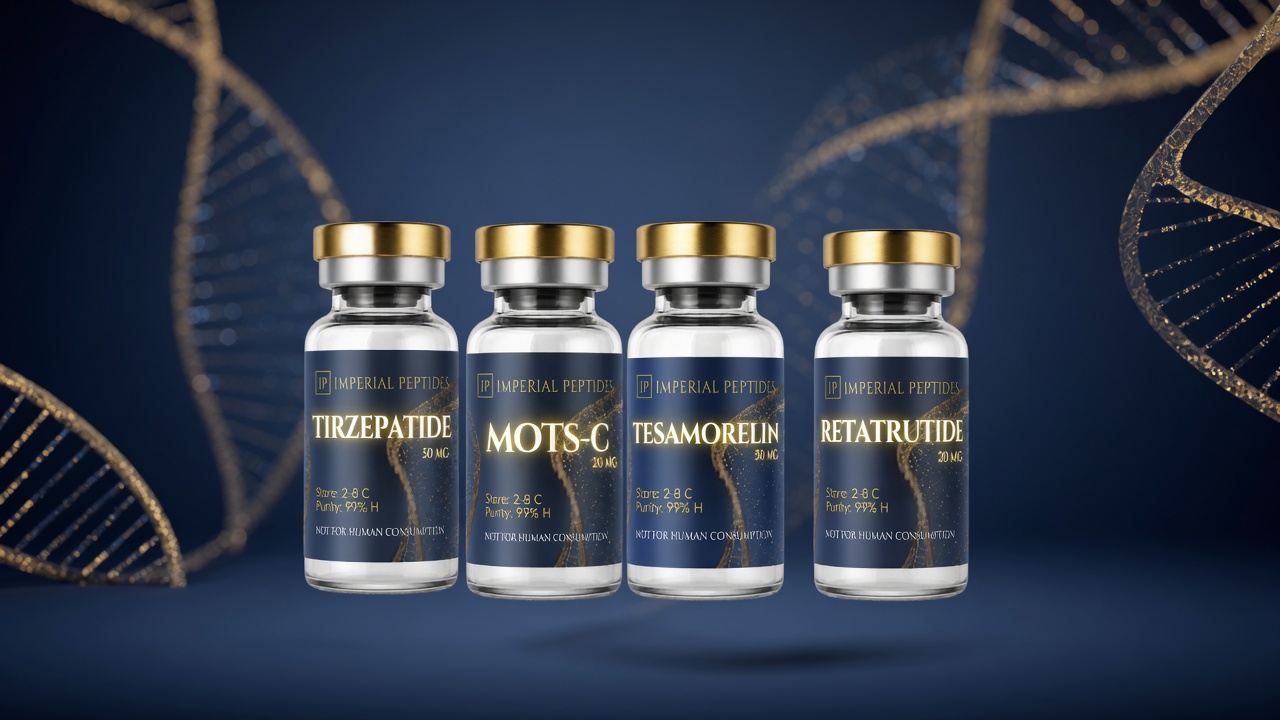
MOTS-c has a big preclinical story and a growing online following. What it has not had, until now, is a registered interventional trial testing whether giving people the peptide changes insulin sensitivity. That trial is recruiting. Results are not in yet.
This post is a research summary for Canadian readers. It reports what published studies and regulators say. It is not medical advice, and it does not suggest that anyone buy, inject, or use MOTS-c or any other peptide.
What is MOTS-c?
MOTS-c is a short peptide encoded in mitochondrial DNA, specifically in a stretch of the 12S rRNA gene. Its full name is mitochondrial open reading frame of the 12S rRNA type-c. It is 16 amino acids long.
A 2015 Cell Metabolism paper from Lee and colleagues introduced it as a signaling peptide that acts mainly on skeletal muscle. In mice, laboratory administration of MOTS-c activated AMPK (a cellular energy sensor), improved insulin sensitivity, and reduced high-fat-diet weight gain and insulin resistance. That work is animal data, not a human treatment result.
What human research exists so far
Exercise and the body's own MOTS-c. In 2021, Reynolds and colleagues reported in Nature Communications that exercise raises endogenous MOTS-c. In 10 healthy young men, skeletal-muscle MOTS-c rose after a bike session and stayed elevated at a four-hour rest check. Circulating levels also rose during and after exercise, then returned toward baseline. The same paper showed that giving MOTS-c to mice improved running performance across young, middle-aged, and old animals. That is still animal-intervention evidence plus a small human observational exercise signal.
Observational levels in metabolic conditions. Human blood-level studies do not all point the same way.
A February 2026 Scientific Reports study (Kutuk et al.) compared 40 women with polycystic ovary syndrome (PCOS) with 40 age- and BMI-matched controls. Serum MOTS-c was lower in PCOS (about 220 vs 498 pg/mL). In a small biopsy subgroup (6 vs 6), skeletal-muscle MOTS-c was also lower. The authors called MOTS-c a potential marker of mitochondrial involvement in PCOS and said interventional work is still needed.
A 2026 observational study in the Journal of Clinical & Translational Endocrinology (PMID 41551324) found the opposite pattern in obesity: circulating MOTS-c was higher in adults with obesity than in lean controls, tracked with BMI and insulin resistance, and did not fall six months after bariatric surgery in a small follow-up group. The authors suggested a compensatory response and called for larger cohorts.
Those papers measure how much MOTS-c is already in the body. They do not test what happens when someone is given synthetic MOTS-c as a drug.
The new Phase 2a trial
ClinicalTrials.gov lists NCT07505745 ("MOTS-MET"), a Phase 2a randomized, double-blind, placebo-controlled study sponsored by Hudson Biotech. Status as of the April 1, 2026 update: recruiting.
Key design points from the registry:
About 120 adults aged 18–65 with prediabetes and overweight or obesity (BMI 27–40)
Randomized 1:1 to investigational MOTS-c or placebo for 12 weeks, plus lifestyle counseling
Primary outcomes: change in OGTT-derived insulin sensitivity (Matsuda Index) at 12 weeks, and treatment-emergent adverse events through week 16
Estimated primary completion: February 2027; full study completion: May 2028
Location listed: Peking University Shenzhen Hospital (China)
Registry flag: not a U.S. FDA-regulated drug product
No efficacy or safety results are posted. Until they are, claims that MOTS-c "improves insulin sensitivity in people" are ahead of the evidence.
What the evidence does and doesn't show
Cells and mice: relatively consistent metabolic and performance signals in published preclinical work.
Humans, observational: endogenous MOTS-c rises with exercise in a small study; circulating and muscle levels differ by condition (lower in one PCOS cohort, higher in one obesity cohort).
Humans, interventional: one Phase 2a trial is recruiting. There are no published randomized results showing that giving MOTS-c improves health outcomes in people.
In short, MOTS-c is a legitimate research target. It is not an approved medicine for metabolic disease in Canada or elsewhere, and online marketing is not the same as trial data.
The Canadian picture
MOTS-C is on Health Canada's warning list. In its April 9, 2026 public advisory on unauthorized injectable peptides, Health Canada listed MOTS-C among products it has seized. It warned that unauthorized injectables may contain the wrong amount of active ingredient, none at all, or contaminants such as bacteria or endotoxins. It also said that "For Research Use Only" labelling "does not make these products legal or exempt from regulatory requirements."
Injectable peptides are generally regulated as prescription drugs in Canada. Unauthorized products have not been assessed for safety, efficacy, or quality. Any future trial readout would still need regulatory review before a licensed product could be sold here.
The bottom line
MOTS-c sits at an interesting moment: strong preclinical biology, mixed human observational findings, and a first proper Phase 2a efficacy trial now underway. The honest takeaway for readers is patience. The recruiting study is designed to answer whether investigational MOTS-c changes insulin sensitivity versus placebo. Until those results are published and peer-reviewed, the gap between lab promise and proven human benefit remains wide.
Sources
Lee C, et al. The mitochondrial-derived peptide MOTS-c promotes metabolic homeostasis and reduces obesity and insulin resistance. Cell Metab. 2015 (PubMed 25738459)
Reynolds JC, et al. MOTS-c is an exercise-induced mitochondrial-encoded regulator of age-dependent physical decline and muscle homeostasis. Nat Commun. 2021
Kutuk IS, et al. Reduced serum and skeletal muscle MOTS-c levels in women with polycystic ovary syndrome are associated with mitochondrial dysfunction. Sci Rep. 2026
Systemic MOTS-c levels are increased in adults with obesity… J Clin Transl Endocrinol. 2026 (PubMed 41551324)
ClinicalTrials.gov NCT07505745 — MOTS-c for Improving Insulin Sensitivity (MOTS-MET)
Health Canada. Think twice before injecting peptides bought online (April 9, 2026)
Disclaimer: This article is for general information and research education only. It summarizes published research and regulatory notices and is not medical advice. MOTS-c and the other peptides mentioned are discussed strictly in a research context. They are not for human consumption, and nothing here recommends or describes their use. Injectable peptides are generally regulated as prescription drugs in Canada; unauthorized products are illegal to sell. Talk to a licensed healthcare professional about any health decision.
Comments